

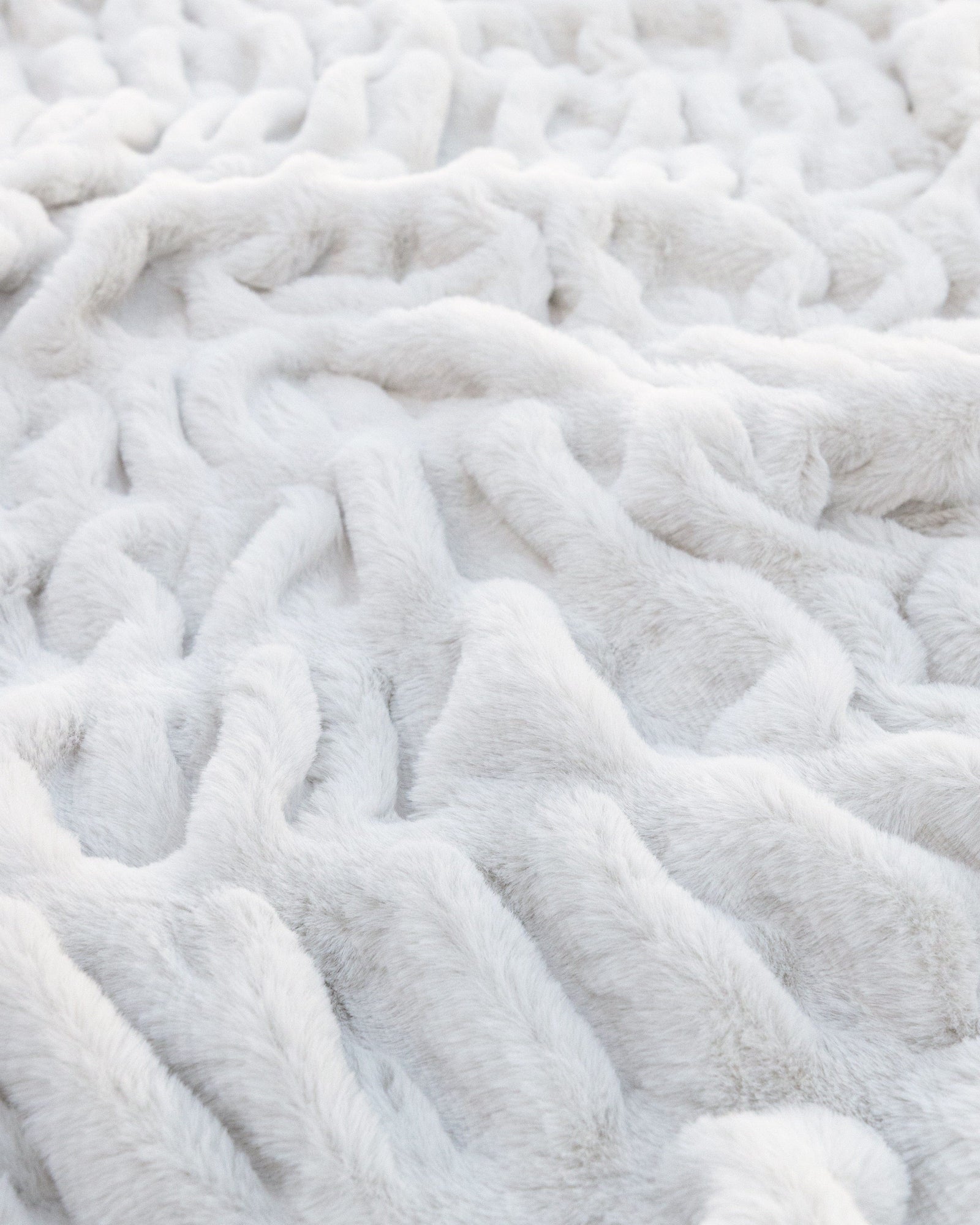
Faux fur has a reputation for being delicate. It is not, particularly. It is just specific. There are four things it wants and three things it genuinely cannot recover from, and once you know which is which the whole business becomes fairly unremarkable.
All of it follows from one idea: the softness lives in the air trapped between the fibres, not in the fibres themselves. Protect the loft and you protect the blanket. Flatten it and no amount of washing brings it back.
If you want the one page version, our care guide has it, and it prints.
Step one: wash cold
Cold water, normal cycle, your regular detergent. Liquid or powder, both are fine, and nothing special is required.
Cold matters because the pile is a synthetic filament, and synthetics soften as they warm. A warm wash will not ruin a blanket by itself, but it starts the process that a warm dryer then finishes. Fibres relax, lie down, and set that way.
Two practical notes. Wash the blanket on its own, or with other soft things. One zip or jean rivet will pull threads out of a pile fabric over time, and it only takes the one. And do not overload the drum. A blanket needs room to move. Packed in tight, it comes out with permanent creases along the fold lines.
For a very large throw, a laundromat machine genuinely beats forcing it into a domestic one.
Step two: no fabric softener, ever
This is the one people find most surprising, because softener sounds like precisely what a soft blanket would want.
Fabric softener works by depositing a thin waxy coating on fibres. On cotton that reduces friction and feels pleasant. On a pile fabric it does something else entirely. It weighs the filaments down and glues them to each other, so instead of standing up individually they clump into small matted groups.
The result is a blanket that looks broadly the same and feels distinctly worse. Dryer sheets get there by a different route and arrive at the same place.
Some good news: this is cumulative and partly reversible. If a blanket has had softener a few times, a couple of plain cold washes with nothing added at all will strip some of it back out.
Step three: skip the pods
Detergent pods are formulated to dissolve at warmer temperatures. In a cold wash they frequently do not fully dissolve, and whatever is left ends up deposited in the pile.
It builds slowly. The blanket goes faintly stiff, a little dull, and nobody connects it to the detergent because the change happened over months rather than overnight.
Liquid or powder, and less than you think. Over-dosing detergent is one of the most common causes of residue in any fabric.

Step four: hang until almost dry
Line dry, or lay it flat over a drying rack or a spare bed. Air does almost all of the work and none of the damage.
The important part is the timing. Take it down while it still feels faintly damp. Not wet, not fully dry. Slightly damp fibres are pliable, which is exactly the state you want them in for the last step.
If you hang it over a single rail, move it once partway through so the fold line does not set. Draped over two lines, or laid flat, avoids the problem entirely.
Step five: a short tumble on the lowest heat
This last step is not about drying. It is about fluffing.
A short cycle on the very lowest heat, or an air dry setting if your machine has one, tumbles the pile back into loft. Fifteen minutes is usually plenty. You are agitating the fibres apart, not removing moisture.
Never high heat. This is the one thing on this page that cannot be undone. A hot dryer can permanently flatten a faux fur blanket in a single cycle, and no amount of subsequent washing, brushing or hopeful steaming will bring the pile back up. If you remember nothing else from this article, remember that sentence.
Wool dryer balls help here and are perfectly safe, because they work mechanically rather than chemically. Dryer sheets do not get the same pass.
Between washes
Most blankets get washed considerably more often than they need to be, and every wash costs you a little.
Shake it out weekly. Thirty seconds outside or over a balcony rail lifts the pile and removes most of the dust.
Spot clean immediately. Cold water, a clean cloth, blot rather than rub. Rubbing tangles the pile and leaves a permanently different-looking patch, which is a worse outcome than the original spill. Work from the outside of a spill inward.
Air it in the shade. An hour outdoors freshens a blanket better than a wash does. Keep it out of direct sun, which fades colour over time and is hardest on the deep shades.
Brush gently with your hand, or with a soft pet slicker brush held very lightly, if one area is matting from heavy use.
Rescuing a blanket that has already gone flat
If the damage came from softener or residue, you have a real chance:
- Wash cold on its own with no detergent at all, essentially a long rinse, to strip surface residue.
- Wash again cold with a small amount of liquid detergent.
- Hang until barely damp.
- Tumble fifteen minutes on the lowest heat with two wool dryer balls.
- Shake it hard, then brush lightly with your hand in the direction of the pile.
Repeat once if it improved but has not fully come back. If it made no difference whatsoever, the loft was almost certainly set by heat, and that one does not return. It is still a warm blanket. It will simply never feel like it did.

Storing it for the season
Clean and fully dry before it goes away. Anything left in the fibres has months to settle in.
Roll rather than fold. Folds compress the pile along hard lines, and those lines can still be visible a season later. Rolled, the pressure spreads out.
Use a breathable cotton bag rather than a sealed plastic bin. Synthetics do not need airtight protection, and sealed plastic traps any leftover moisture against the fabric.
And do not stack heavy things on top. Months of compression does the same job heat does, just with more patience.
The whole thing in one line
Cold wash, no softener, no pods, hang until almost dry, short tumble on the lowest heat. Shake it out between washes and never let it near a hot dryer.
Do that and the blanket you buy this year will feel the same in five.
The printable care guide · Shop the Cloud Collection · Ask us a care question