

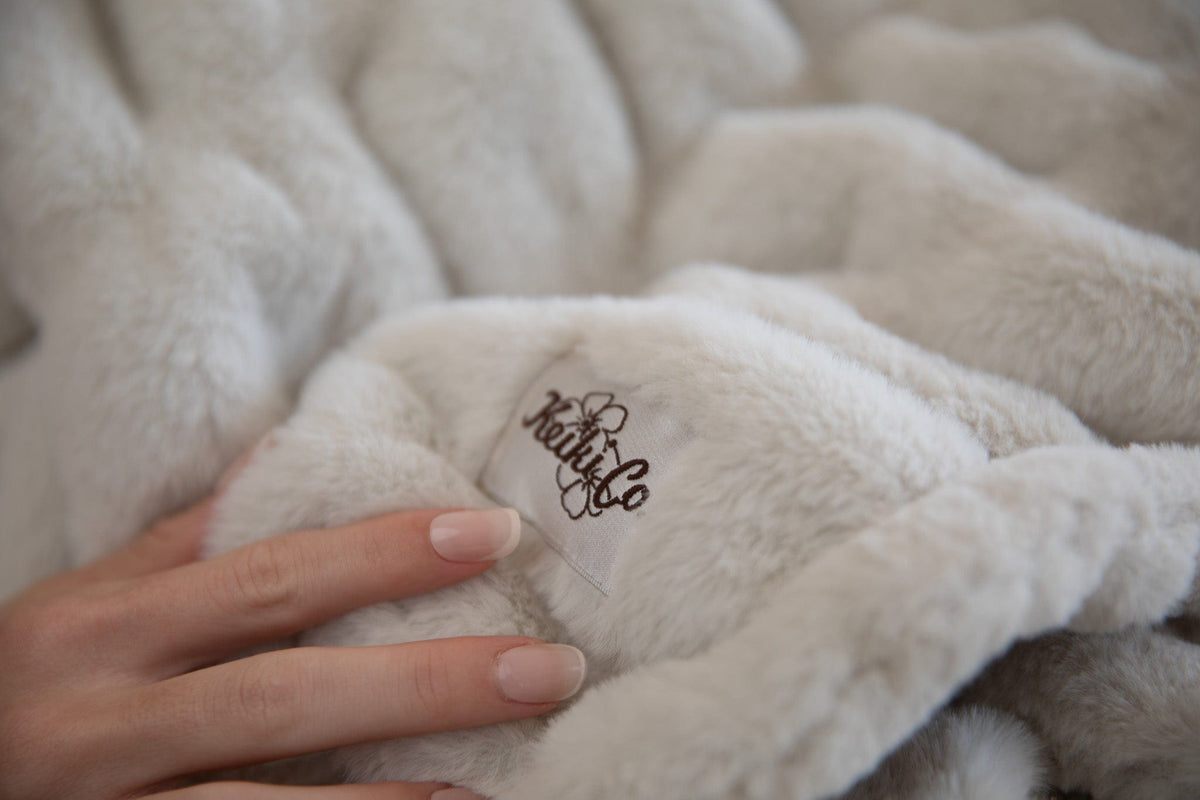
Everyone knows the feeling. You pull a blanket over yourself and, somewhere in the first few seconds, your shoulders come down about an inch. It is such a reliable little moment that it is easy to file under sentiment rather than something with an actual explanation.
It has one. Several, in fact. They are worth knowing, because they are also the things that separate a blanket you keep for a decade from one you quietly retire after a winter.
Warmth is mostly air, not fabric
The first surprise is that a blanket does not really warm you. You warm you. The blanket's entire job is to slow down how fast that heat leaves.
Still air is a poor conductor of heat, which makes it an excellent insulator. What a high-pile fabric actually does is trap a deep layer of air against your skin and hold it still. The fibres themselves matter far less than the space between them.
This is why loft, the height and springiness of the pile, is the number that counts. A tall, dense pile holds a thicker cushion of still air than a flat one at the same weight. It is also why a crushed, matted blanket stops feeling warm long before it looks worn out. Squeeze the air out and you have removed most of the insulation.
Same principle as a down jacket, a double-glazed window, or a pigeon on a cold morning. The material is scaffolding. The air is the point.

Softness is not one thing
We use a single word for at least three separate qualities, which is why "soft" is such a useless thing to shop by.
Fibre fineness is how thin each filament is. Finer filaments bend more easily against skin, so the fabric yields instead of scratching. It is the same reason fine merino feels nothing like a cheap wool jumper despite being the same animal.
Surface geometry is what your fingertips read first. Cut pile or looped, dense or open, uniform or ruched. A hand-ruched surface has hills and valleys, so your skin never meets one flat plane. That variation is a big part of why some fabrics feel alive under your hand and others feel like a sheet of fleece from a hotel gift shop.
Recovery is what happens after you press. Good pile springs back. Poor pile keeps the dent. Recovery is invisible in a photograph and obvious within a week of real use, and it is the single quality that best predicts whether a blanket still feels good in year three.
The part about touch
Here is the genuinely interesting bit. Not all touch takes the same road to your brain.
Alongside the fast nerve fibres that handle pressure and precision, the ones that let you find a key in your pocket without looking, human skin carries a slower system that responds best to gentle stroking at roughly the speed of a hand moving across an arm. These fibres live in hairy skin rather than on the palms, and they do not appear to be about identifying objects at all. They are associated with the pleasantness of touch rather than the information in it.
That goes a long way toward explaining why running your hand across a deep pile is satisfying in a way that touching a smooth surface is not, and why the feeling is so hard to put into words. You are not gathering data. You are stimulating a system that seems to exist mainly to register that contact feels nice.
It is also why the first thing any human does with a faux fur blanket is pet it. Nobody is inspecting the fabric. They are just enjoying themselves.
Weight, and the reason you settle
A substantial blanket does something a light one cannot. It applies broad, even, gentle pressure across a large area of the body.
You already know this sensation from other places. A firm hug. A hand on the shoulder. A heavy quilt on a cold night. Even, distributed pressure tends to feel steadying in a way that light contact does not, and it is a large part of why a generous blanket feels calmer than a thin one of the same warmth.
Which is one more argument for buying bigger than you think you need. Size is not only about coverage. A throw with real presence changes how it feels to be underneath it.

What actually ruins it
If loft is the source of both the warmth and the feel, then anything that flattens the pile is the enemy. There are three real culprits and all three are avoidable.
Heat is the worst of them. Synthetic pile softens at high temperatures and sets in whatever position it cools in. A hot dryer can flatten a blanket permanently in one cycle. This is the only damage on this list that cannot be undone.
Fabric softener and dryer sheets work by leaving a thin waxy film on the fibres. On a towel that costs you absorbency. On a pile fabric it weighs the filaments down and sticks them together, so they stop standing up and stop trapping air. The blanket looks about the same and feels noticeably worse, which is a frustrating combination.
Detergent residue does the same thing more slowly. Pods in particular are formulated to dissolve in warmer water, so in a cold wash they can leave a little of themselves behind every time.
Everything in our care guide follows from one idea: protect the air.
How to judge any blanket in five seconds
Press your palm into it and lift. Does the pile come back on its own, or is your handprint still sitting there? That is recovery, and it is the most useful quick test there is.
Then look at it edge on rather than face on. Depth is visible from the side and nearly invisible from the front, which is exactly why so much of it disappears in product photography.
Then pick it up. Weight spread across a large area is comfort. Weight concentrated in a small one is just a heavy blanket.
None of this is complicated and none of it is magic. It is air, geometry, and a nervous system with a channel dedicated to this precise feeling. The deep exhale you take is not sentimental. It is the entire point.
Feel the Cloud Collection · Compare every material · Read the care guide